I spend most of my days thinking about breasts. Where a seam should fall, how lace sits against skin, how an underwire curves under a breast so it supports her and doesn't dig in. It's my job to know breasts well.
But the most important thing I can tell you about your breasts has nothing to do with lingerie. It's this: know what's normal for you. October is Breast Cancer Awareness Month, and this is my small part of it: a five-minute check you can do once a month, in your own bathroom, before you get dressed.
Breast cancer hasn't touched me personally, and I'm grateful for that every day. But there's a known cancer risk in my family, so I don't leave it to chance: I have my breasts checked by a doctor every six months.
It takes less time than a coffee date, and I walk out lighter every time. If cancer runs in your family too, tell your doctor. You may be able to start screening earlier or go more often.
Agate
Why October, and why pink?
Breast Cancer Awareness Month has been marked every October since 1985. Its purpose has always been simple: get women talking, checking, and going to their screenings. The pink ribbon came later, and it has a story worth knowing
The numbers above can feel heavy. But look at the last one again. Finding a change early is one of the best things you can do for yourself, and in high-income countries, breast cancer deaths have fallen dramatically since the 1980s That's what awareness is for.
First, know your normal
There's no "perfect" breast. Every body is different, and so are your two breasts. One is often slightly bigger than the other (I see it all the time in the atelier, and it's completely normal). Breasts also change with your cycle: they can feel fuller, lumpier, or more tender in the days before your period, then settle again afterward.
That's exactly why a monthly check works. You're not looking for perfection. You're learning your normal, so you notice when something is new. Most breast lumps turn out not to be cancer but every change deserves to be looked at.
When to check: if you have periods, a few days after it ends is easiest, when breasts are least tender. If you don't have periods, pick a date, like the 1st of the month, and stick to it.
How to check your breasts in 3 steps
Look in the mirror
Stand topless in front of a mirror with your arms by your sides, then raise them above your head. Look for any change in size, shape, skin, or nipples.
Feel, in small circles
Use the flat pads of your fingers, not the tips. Press in small circles, from light to firm pressure, never painful. Cover the whole breast, up to your collarbone and into each armpit. In the shower or lying down is often easiest.
Don't skip the nipples
Feel around and over each nipple. Notice any discharge or any change in position.
Signs to see your doctor about
Book an appointment with your doctor if you notice any of these changes, even if you feel completely fine. Don't wait for your next routine visit, and don't talk yourself out of it.
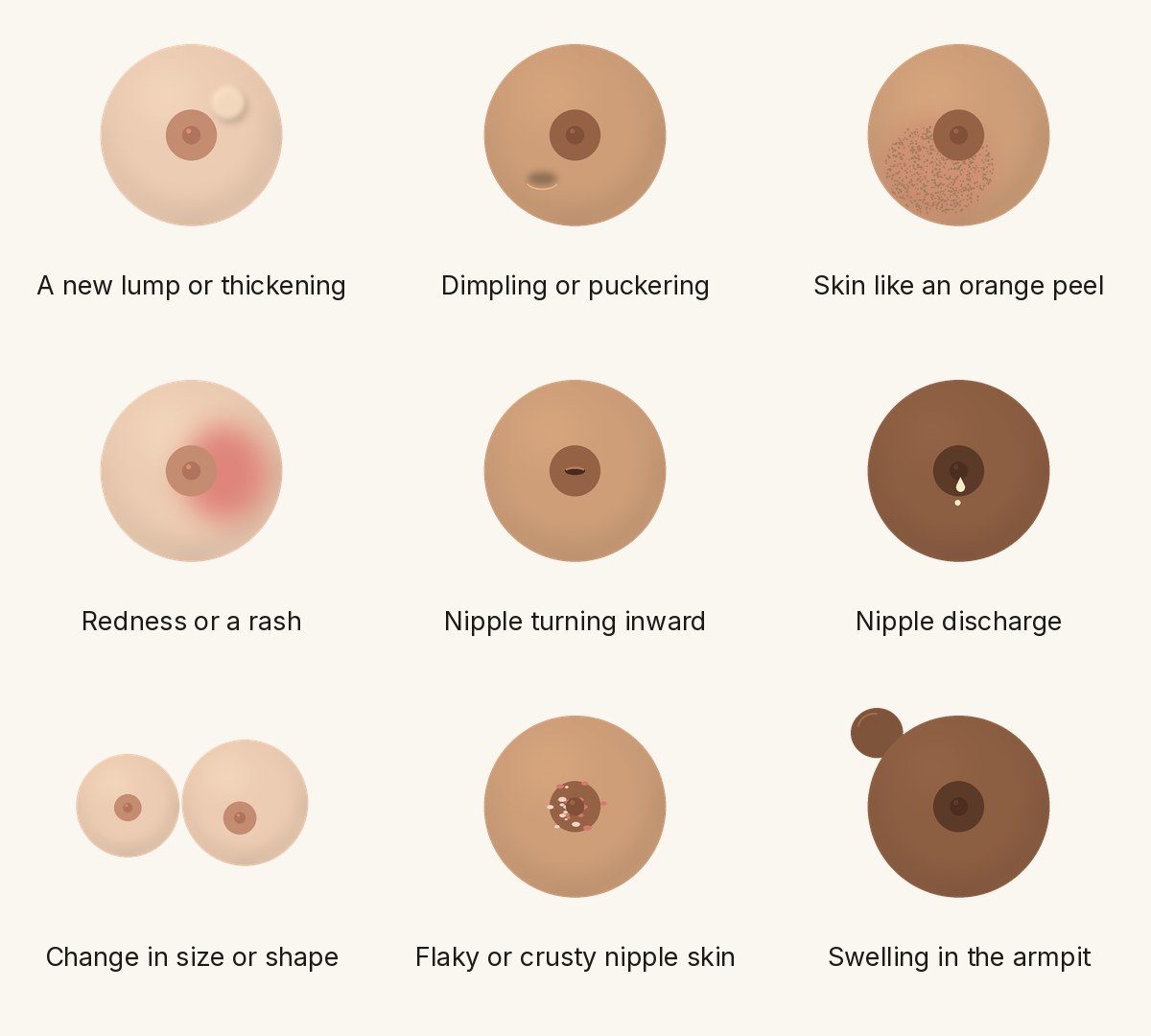
- A new lump or thickening in your breast or armpit
- A change in the size, shape or feel of a breast
- Skin dimpling, puckering, or skin that looks like an orange peel
- Redness, a rash, or red, dry, flaking or thickened skin
- A nipple that turns inward or changes position
- Fluid from the nipple when you're not pregnant or breastfeeding
- Swelling under your arm or near your collarbone
- Pain in your breast or armpit that doesn't go away
You know your body better than anyone. If something feels different, trust that feeling.
Your bra and breast cancer: myths vs. facts
As a lingerie maker, I hear these questions a lot. Here's what the research actually says.
"Underwire bras cause breast cancer."
A 2014 study of 1,513 women found no link between breast cancer and underwire bras, how many hours a day a bra is worn, or the age you started wearing one.
"Sleeping in a bra is dangerous."
The same study found daily hours of bra-wearing made no difference to risk. Wear one at night if it's comfortable, skip it if it isn't.
"Antiperspirant causes breast cancer."
The American Cancer Society says there's little scientific evidence for this, and expert agencies have found no conclusive link.
"Only women get breast cancer."
Roughly 0.5 to 1% of breast cancers happen in men. Send this to the men in your life too.
What a bra can do is help you notice. When you know how your favorite bra usually fits, you'll often be the first to feel when something about your breast has changed: a cup that suddenly gaps on one side, a strap that sits differently, a spot that feels tender under the wire. Pay attention to those little messages.